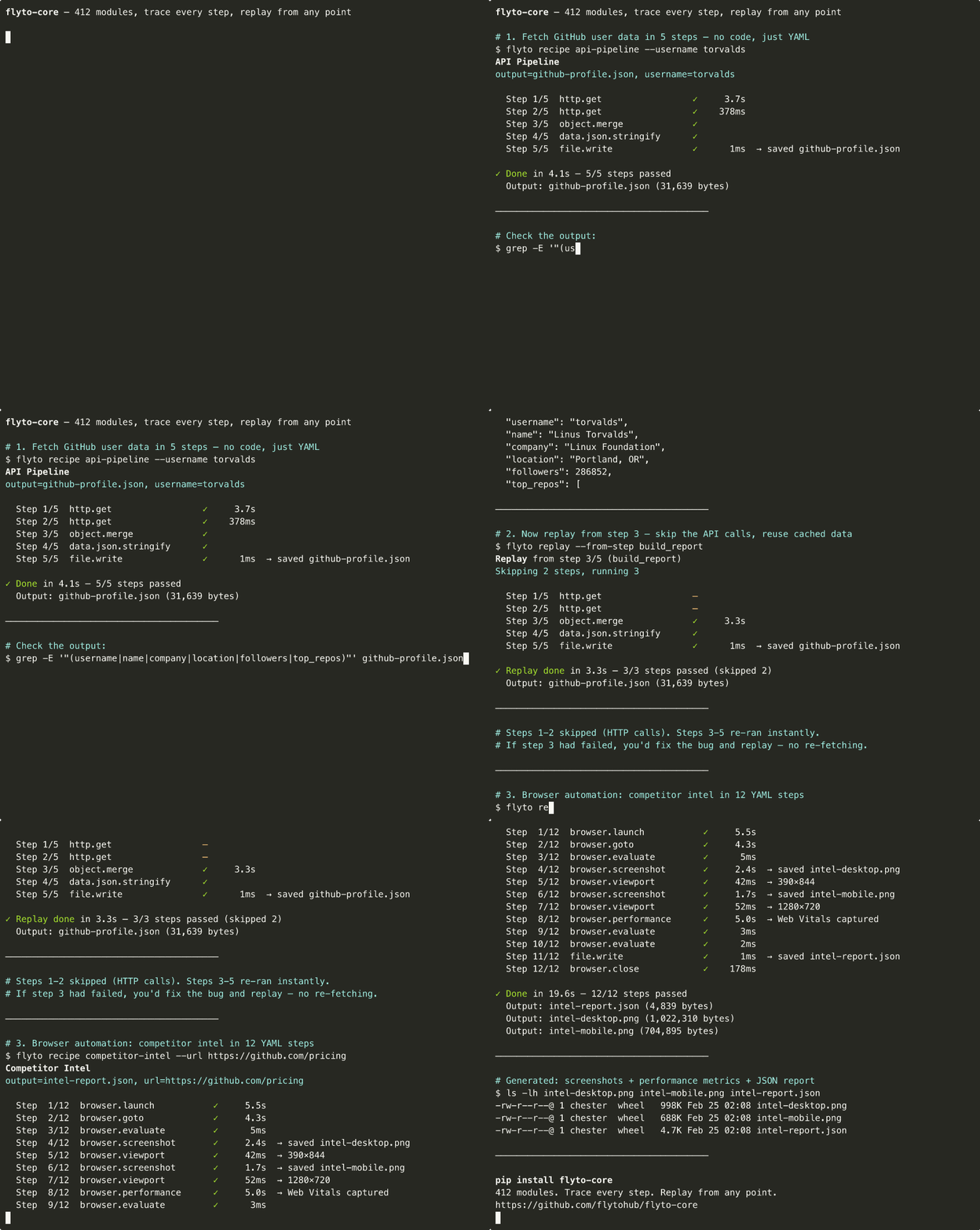
Flyto2 Core is a Python execution engine that runs browser, API, and data work for AI agents as explicit steps. It records what every step did and replays a failed workflow from the step that failed, rather than re-running the whole job.
Workflows are YAML files that chain registered modules, each with a bounded parameter schema. The registry holds 482 modules in 89 categories, covering browser automation, flow control (loops, branches, parallel runs, retries, circuit breakers, rate limits), API calls, data transforms, files, verification, crypto, and AI model calls. Packaged recipes such as a site audit, a competitive pricing capture, and a scrape-to-CSV job ship ready to run, and you can write your own in the same format.
Every run produces an execution trace with each step's input, output, timing, and status, plus state snapshots before and after each step. You can replay from any step with the original or modified context, pause at breakpoints to inspect state, and follow data lineage across steps.
The same engine runs behind four interfaces: a CLI, an MCP server (stdio or Streamable HTTP) that gives clients such as Claude Code, Cursor, and Windsurf every module as a tool, an authenticated HTTP execution API, and a Python API. Modules that take a caller-supplied path go through a filesystem sandbox, and modules that take a URL or host go through a server-side request forgery (SSRF) guard. Flyto2 Core is the execution layer of a larger Flyto2 family that also covers routing and reusable procedure storage, but it runs workflows on its own.
| Category | Modules | Examples |
|---|---|---|
| browser.* | 54 | launch, goto, click, evaluate, screenshot, performance |
| flow.* | 24 | switch, loop, branch, parallel, retry, circuit breaker |
| api.* | 13 | OpenAI, Anthropic, Gemini, Notion, Slack, Telegram |
| data.* | 13 | JSON, YAML, CSV, XML parse and convert |
| ai.* | 10 | chat, vision, embeddings, moderation |
| verify.* | 9 | evidence, visual diff, rulesets |
| 83 other categories | 319 | arrays, strings, files, crypto, HTTP, Docker, Kubernetes, PDF, AWS, git |
Features
- Replay from any step: re-executes a workflow from the failed step with prior context preserved
- Execution trace: structured record of every step's input, output, timing, and status
- Breakpoints: pause at a step, inspect state, and resume
- Evidence snapshots: full state captured before and after each step boundary
- Data lineage: tracks data flow across steps and builds dependency graphs
- Timeout guard: workflow-level and per-step timeouts
- YAML workflows: compose registered modules into replayable procedures
- 482 modules: browser, flow control, API, data, files, verification, crypto, and AI calls across 89 categories
- Packaged recipes: 41 built-in recipes, including site audits and scrape-to-CSV jobs
- MCP server: exposes every module as a tool to MCP clients over stdio or Streamable HTTP
- HTTP and Python APIs: run workflows, replay steps, or execute single modules programmatically
- Sandboxing: filesystem sandbox for caller-supplied paths and an SSRF guard for caller-supplied URLs